
Laboratory Introduction Special Content 2026
We have summarized frequently asked questions in a Q&A format. Please click on a question to see the answer.
The name of our lab is an original name, so it may be hard to imagine, but our research has two main pillars: computer vision, where computers understand scenes through cameras, and computer graphics, where computers generate images. In computer vision, we estimate the 3D shape, color, and material of objects. In computer graphics, we aim to reproduce the appearance of real objects and generate CG that looks the same as real ones.
We also study computational photography, which may be an unfamiliar term. By combining image capture with computation, we extend the basic principles of cameras and improve their performance in new ways. It can visualize information that cannot be captured by normal cameras, in other words, it makes invisible things visible. For this reason, it is attracting attention in industry.
In recent years, we also focus on deep learning. Instead of ignoring the physics of light, we study learning methods based on physical models, and combine them with our strong optical sensing technologies.
Several projects funded by competitive research grants are ongoing, and we also have joint research with multiple companies. In general, a list of research topics related to these projects is provided, and students choose from it freely. On the other hand, students can also set their own topics based on their strong interests.
In these funded projects, many studies use special cameras such as hyperspectral cameras, Time-of-Flight cameras, and thermal cameras.
These are the titles of Master's theses in 2025.
- Low-Dimensional modeling of discrete Vortical structures with a Mixture of Gaussian-Weighted Geometric Transforms
- Human Body State Estimation from Low-Resolution Far-Infrared Images
- Virtual Restoration of the Izumizaki Yokoana 3D Model using Differentiable Rendering and Diffusion Model from Frontal Restoration Image
- Light Field Measurement Using an Event-Based Camera with Sub-Aperture Epitrochoid Sampling
- Hyperspectral Analysis of the Izumizaki Tomb Mural through Latent Variable Learning of Substrate and Pigment
- Four-Dimensional Visualization of Numerical Weather Prediction Models Using Compact Continuous Function Representation of Advection
- Anime In-Betweening Using Video Diffusion Models via Depth Conversion and Line-Art Warping
- Depth from Focus with Test-Time Optimization\\of Monocular Depth Estimation Models
These are the titles of Master's theses in 2024.
- Neural Geometric Transformation Field for Non-Rigid Registration
- Visualization of Overwritten Characters in Drafts of Modern Writers Using Spectroscopy
- Arbitrary Viewpoint Event Camera Simulator Based on a Neural Radiance Field
- Efficient Depth Interpolation of Confocal Images using Diffusion Models and Neural Fields
- Estimation of cloud flow on a sphere using geometric transform field for real-time precipitation forecasting
- Performance Validation of Depth from Focus in Real-World Scenes and Investigation of the Impact of Focal Stack Acquisition Conditions
- Laser Speckle Authentication Robust to Object Misalignment along the Optical Axis by Iterative Phase Retrieval
- Snapshot Hyperspectral Imaging Using Petrographic Thin Section Based Spatial-Spectral Filter and Self-Guide Image
- Investigation of Scratch Emphasis Method in CG Representation of Metal Cutting Surfaces
- Non-destructive Separation of Stuck Photographic Plates Based on Light Transport Measurement
- High-Efficiency Fluorescence Multiplex Imaging Using Dye Coding with a Liquid Crystal Variable Retarder
These are the titles of Master's theses in 2023.
- Sensor Pose Estimation from Low-Resolution SPAD Sensor Measurements
- Simultaneous estimation of identical color regions and color labels in patch-based automatic colorization of cartoon line drawings
- Separation of characters written on stuck paper based on reflectance and transmittance
- Depth Estimation with Deep Depth-from-Defocus considering Camera Parameters
- Visualization of Scratches on Metal Cutting Surface
- Future morphology prediction: Using machine learning models to simulate the development of organoid
- Estimating Soil Moisture Content Utilizing Environmental Changes Using Thermal Camera
- Improving Robustness against Misalignment in Object Authentication Using Laser Speckle
- Updating Human Pose Estimation using Event-based Camera for Latency Compensation
- Light field measurement by refractive Lissajous sampling using a pair of wedge prisms

Each student is assigned a different research topic. However, students do not work completely independently. They form groups based on similar topics and share tools and ideas. Each group has a meeting once a week, where students report their progress, discuss problems, and ask questions.
In addition, there is a weekly meeting with all members. Several students give presentations on their research progress in a conference style, and introduce papers from recent international conferences. Through this, students can understand not only their own research, but also the activities of the whole lab, and learn about state-of-the-art research.
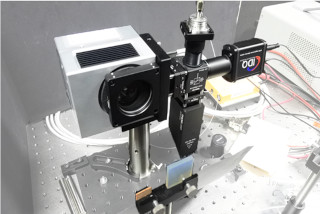
Since optical measurement is one of our main research topics, we have a wide range of equipment such as cameras, lenses, and light sources. In particular, in addition to consumer cameras, we have special cameras such as hyperspectral cameras, depth (ToF) cameras, and thermal (far-infrared) cameras. We also have a large dark room where ambient light is controlled, which allows us to perform various kinds of optical measurements.
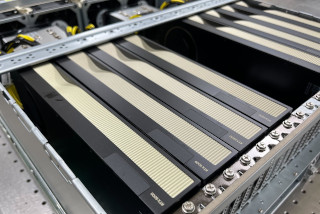
Deep learning requires strong GPU computing resources. For this reason, in addition to cloud services, our lab has many GPUs, and we maintain an environment where experiments can be done at any time.
- RTX Pro 6000 (96GB) x 4
- A6000 (48GB) x 3
- A100 (80GB) x 2
- RTX6000 Ada (48GB) x 7
- Quadro RTX8000 (48GB) x 2
About 80 students have completed the Master's program. Their main employers, including group companies, are electronics companies such as Panasonic (11), Mitsubishi Electric (4), Sony (6), Hitachi (3), and NEC. Because many students work on camera-related research, some also join companies such as Ricoh (2), Canon (2), and Olympus. Some students also work in the mobility industry, such as Honda (2), Denso (2), Mazda, and Yamaha Motor. In addition, more students are joining industrial companies such as Kubota (3) and Yanmar. In recent years, more students have joined IT and telecom companies such as NTT Docomo, NTT Data, Yahoo (2), SoftBank (2), Rakuten, and DMM.
So far, 7 students have completed the Doctoral program. They work at Kyushu University, National Institute of Informatics, SenseTime Japan, Optech Innovation LLC, Asahi Kasei, National Institute of Advanced Industrial Science and Technology (AIST), and Tokyo International University.
In recent years, we mainly use Python. It is used for a wide range of tasks such as camera control, numerical computation, and deep learning. Programming skills are helpful, but not required. Many students start with little or no programming experience, and learn programming while working on their research.
We encourage a healthy lifestyle, such as coming in the morning and going home in the evening, but we do not set strict core hours. Attendance at regular lab meetings is required, but outside of that, students have some flexibility as long as they make proper progress in their work. Job hunting is an important event, so if students inform us in advance, they are allowed to miss regular meetings.

We aim to create a bright, clean, and comfortable lab environment. In addition to individual desks, we have a large space where students can talk and share information. In the "Creative Circle" near the entrance, various information is naturally shared. The doors of faculty offices are also open, so students and faculty share one large open space.
Including graduates, the number of regular international students is: China (12), Belgium (1), Tanzania (1), Indonesia (1), Brazil (1), Mexico (2), Pakistan (1), and Bangladesh (1). Short-term visitors so far include France (11), the United States (1), and Germany (2). In particular, we have long-term collaborations with universities in France and the United States, so there is active exchange of researchers and students.

Each student sets up a work environment that is comfortable for them. In the Information Science area, each student is provided with a MacBook Air. In addition, they also use Windows laptops in the lab. Multiple displays are available, and students arrange them in ways that make their work easier.